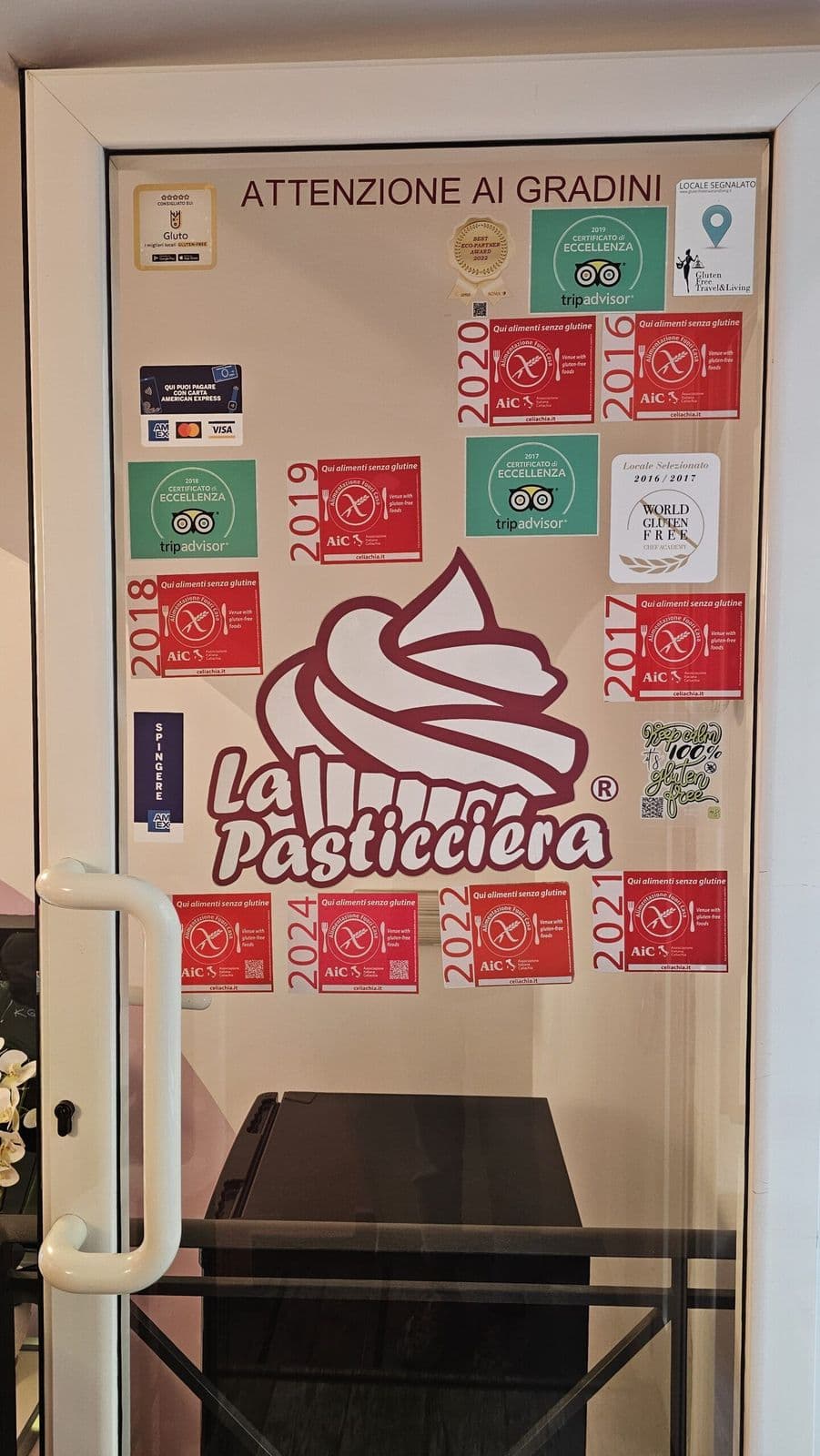
This page explains the gluten-free words used on the NOGLUTEATALY guides, and it repeats only the safety practices the site already states. It does not add a fryer checklist, a visit log, or a rule for when a stop is dropped. Those details are not published.
What the Labels Mean
“100% dedicated gluten-free” means the venue says gluten is not used in that kitchen. “AIC-affiliated” means the venue says it belongs to the Associazione Italiana Celiachia network, including the Alimentazione Fuori Casa programme some restaurants name on their own sites. That is a different sentence from “no gluten is used.” “Gluten-free menu with separate prep” means the venue also cooks with gluten and describes a separate gluten-free kitchen, oven, or laboratory. “Gluten-free options only” means the venue offers gluten-free dishes and does not describe separate preparation. Ask which of those applies before you order.
The pizza guide, the gelato guide, the bakery guide, the carbonara guide, and the Colosseum and Vatican guide use those four labels. The cards are independent venues. They are not a list of tour partners, and a card is not a medical guarantee.
Cross-Contact and Residual Risk
Cross-contamination, also called cross-contact, is gluten from a shared surface, a shared fryer, shared pasta water, a shared scoop, or flour reaching a gluten-free plate. The FAQ says a minimal residual risk can never be completely eliminated in any food environment. The published commitment is to reduce that risk as far as reasonably possible, to say so plainly, and not to promise a zero-risk meal. Say you are celiac when you order, including at a place that already marks a gluten-free dish.
What NOGLUTEATALY Already States
The FAQ says each tasting stop is vetted for celiac safety. Partners are typically fully gluten-free, use a separate kitchen or dedicated gluten-free prep, or follow trusted protocols. The same answer says generic restaurants without proper separation are not added. Staff are spoken with before each visit. At the start of a food tour there is a short safety check on each guest’s sensitivity. Suitability is confirmed before each season. Tell us about celiac disease, other allergies, and non-celiac guests before the experience. For other allergies, the FAQ says the experience can often be adapted and is always confirmed in advance.
The cooking-class pages say the class is a fully gluten-free environment. Only gluten-free ingredients are used. Equipment, utensils, and surfaces are dedicated to gluten-free cooking and are not shared with gluten-containing food. Gluten is not present during the class. The shared class is the bakery class. The private class uses the same kind of kitchen wording for a group of exactly 2 adults.
The Pasta Lovers’ itinerary says the seated carbonara or amatriciana is made in a dedicated gluten-free kitchen, and that everything in that tour’s gelateria is 100% gluten-free. The itinerary does not print the gelateria’s name. The dinner schedule is Sunday, Tuesday, Thursday, and Saturday at 17:00.
Are gluten-free food tours in Rome safe for celiacs?
They are designed for celiac guests, with the vetted stops and the residual risk described in the safety FAQ. That FAQ does not remove the residual risk.
What is the difference between AIC affiliation and a dedicated kitchen?
AIC affiliation means the venue says it is in the Italian Celiac Association network. A dedicated kitchen means the venue says gluten is not used there. A venue can state one of those without stating the other. The venue cards keep them as separate labels.
What should I tell the guide before a tour?
Tell us if you are celiac, if you have another allergy, and if non-celiac guests are with you. The food-tour FAQ says the guide asks about sensitivity at the start of the tour.